Wednesday, 2 October 2013

Music Playlist for 29th September 2013.


·       Rare Old Mountain Dew by Foster and Allen.

·       The Emigrants Story by Jack Carey.

·       Superstition by Stevie Wonder (Live at the White House) youtube.

·       My Special Child by Sinead O’Connor.

·       Seven Drunken Nights by The Dubliners.

·       The Parting Glass by The Clancey Brothers and Tommy Makem.

Poteen.


Poteen.

It has been said that poteen has been produced in Ireland ever since the first potato was plucked from the ground. The name Poteen means little pot and is supposed to reflect its small scale production.

According to legend St. Patrick was said to have been responsible for introducing poteen to Ireland in the fifth century A.D.  Having run out of mass wine he brewed up the first batch of poteen. However, I would suggest that this is a complete fabrication and has more to do with the fact that Christian monks recorded the practice of poteen making in written form and as with a lot of other urban myths concerning St Patrick it has become part of Irish folklore.

There are many stories that include the clergy and poteen. One story tells us about a priest in Kilkiernan who was fined £100 when the authorities found poteen in his church. The money was given to the Archbishop of Tuam to use as he wished, he used it to purchase the bells for Tuam Cathedral and they still ring out to this day.  Because of this they are sometimes called the Alco Chimes by some locals.

In fact one of the earliest records of distilling aqua vitae or the water of life also has a religious connection. In the Exchequer Rolls of 1494 it was recorded that eight bolls of malt were delivered to Friar John Cor to make whiskey. Distilled spirits were commonly made in monasteries for medical purposes and were often prescribed for the preservation of good health and as a general cure all. There were monastic distilleries recorded in Ireland in the late 12th century.  The medical benefits were formally endorsed in 1505 when the Guild of Surgeon Barbers was granted a monopoly over the manufacture of aqua vitae which they used when carrying out surgical procedures.

Of course there have been many in the medical profession who have condemned poteen as highly dangerous and warn of the very real threat of alcoholic poisoning and they also claim that it was responsible for a huge problem with alcoholism in rural Ireland.  They also pointed out the increase in mental illness and it was suggested at one time that more than half the people in the mental asylum in County Mayo were there from the effects of poteen drinking.  However, in 1730, one doctor claimed that drinking poteen to the point of intoxication held off old-age, aided digestion, enlightened the heart, and quickened the mind.  I would not recommend this advice folks.

In Ireland we hold a wake for someone who has died and one suggestion for this was said to be because of the after effects of poteen. It was said that people didn’t know if those who were lay as if dead were just unconscious or were actually dead so they used to wait up at night for them to wake up, hence the name.

 A more recent story which is probably a myth is that it was called a wake because of the frequent lead poisoning suffered by people drinking from pewter tankards.  One of the symptoms of lead poisoning is that of a catatonic state that resembles death from which you would hopefully recover in anything from a few of hours to a couple of days.  It was for this reason that a burial was delayed to give the poor unfortunate a chance to wake up.  I’d make your own mind up about that one.

It was in 1661, that King Charles II, attempting to re-build the post-war treasury, decided to introduce a charge on spirits. In Ireland.  private stills were outlawed and a large section of the Irish population became criminals at the stroke of a pen.  The Irish promptly ignored the tax  and the making of poteen was forced to go underground.  In 1770, the English tried to clamp down on the trade once again but it did very little to slow down production and poteen making took off as a thriving cottage industry. The stills were moved from cottage to barn then to small shacks in the hills and mountains.  Some enterprising individuals set up stills in ancient burial chambers (I wonder if that’s why they are called spirits), some set up on small islands in the middle of lakes, so they could see the guards coming and one fellow even had his still set up on a small boat on Lough Erne. It was said that for many years he was able to out row the local Gardaí .

There is a wealth of folklore regarding poteen. Leprechauns are frequently found in a drunken state caused by poteen.

Poteen made in fairy mounds is seen as magical and it was used for curing painful rheumatic joints, half a cup given morning and night was said to be a cure for all ailments.

It is said to be especially potent if a housewife left fresh cream and bread by a fairy mound at night and asked the fairies for a cure for illness. The fairies would then leave a cup of poteen outside the cottage door to heal the sick.

Poteen made from the water of a fairy spring or sacred well also gave it healing properties and it was used by wise women like Biddy Early in medicinal cures.

Drinking poteen on a fairy hill at night will call the fairies to you and in exchange for a drink they are said to grant you a wish in return. However, give them too much and you may end up as their permanent guest.  Drinking poteen is also said to be responsible for hallucinations. I’m saying nothing.

Irish Contributions To The World.


Irish contributions to the world.


Ireland has long been recognised as the land of saints and scholars. However, over the years we have been major contributors in the field of invention and here are just a few. If you know of others and there are many why not post a comment on my blog page or on my fascebook page at www.facebook.com/pullupachairandsitawhile

Cheese and Onion Crisps

At one time you could only get potato crisps in one flavour, plain with salt.  However, in 1954, along came an Irishman of the name Joe ‘Spud’ Murphy, a pure genius.  It was he who in a kitchen on Dublin’s Moore Street developed the now classic Cheese and Onion flavour and the rest is history.

The Submarine.

In 1878, John Philip Holland, an engineer born in Liscannor, County Clare not only developed the first submarines for both the U.S. Navy and the British Royal Navy at the turn of the last century but he also built one for the Fenians.  It was 14foot long and weighed three tons.  The invention of the submarine has allowed us to explore the depths of the oceans.

The Tractor.

Harry Ferguson, born in County Down developed the first four wheel drive Formula One car and was also the first Irishman to build and fly his own plane.  In 1929 he also gave us the modern tractor.  His name lives on in the Massey-Ferguson Name.


Chemistry.

Robert Boyle, born in County Waterford came up the foundations of modern chemistry in 1661 when he published The Sceptical Chemist.

Nuclear Physics. 1944.

Ernest Walton could also be described as the inventor of a new field of scientific endeavour, and he was also from Waterford. Born in 1903 in Dungarvan, Walton, together with John Cockcroft, was the first person to artificially split the atom, thus creating nuclear physics and making possible power-stations, A-bombs and everything they brought with them. In 1951, he became Ireland’s only Nobel science laureate, when jointly awarded the Prize for Physics.

The White House.

An architectural competition was held to find an architect that could design a House for the U.S. President, George Washington.  Washington had long admired the work of James Hoban, in particular Charleston County Courthouse which he saw when visiting the southern states and he gave the Kilkenny man the commission.  Hoban was influenced by our own seat of government, Leinster House in his 1800 design, so in effect you might be forgiven for referring to Leinster House as ‘The Green House’.


The Guided missile.

Louis Brennan, was born in Castlebar County Mayo in 1852. He was the inventor of the world’s first guided missile.  It was a torpedo type device which was used as a coastal defence weapon.  Fired in 1877 for 2000 yards or 1800 metres it was called the world’s first guided missile, it obtained a speed of 23 miles per hour.  Brennan also designed a monorail and a helicopter. Ironically for a man who lived for machines, he was killed when he was struck by a car.


Guinness.

Beer drinkers around the world have the Irish to thank for the invention of the Black Stuff. The stout, which is the best-selling alcoholic drink of all time in Ireland, but also popular globally, originated in the brewery of Arthur Guinness at St. James’s Gate, Dublin. On 31 December 1759 he signed a 9,000 year lease at £45 per annum for the unused brewery.


In the field of literature we have, Jonathan Swift, Gullivers Travels.  C.S. Lewis, Chronicles of Narnia. Bram Stoker, Dracula.  Sheridan Le Fanu, Uncle Silas.  Oscar Wilde, Playwrite.  J.M. Synge ,W.B. Yeats, James Joyce, Samuel Beckett, Brendan Behan and John B Keane to name just a few.

.

The induction coil -- found in car ignition systems, TVs and other electronic devices -- was invented by scientist and priest Nicholas Callan in 1836. Callan was from Darver in Co Louth, and he studied at Sapienza University in Rome. After returning to Maynooth as the new Professor of Natural Philosophy (what they called Physics back then), he began working with electricity in his lab -- which sounds like something Baron Frankenstein might have done. In 1837, he was generating an estimated 600,000 volts -- enough to give life to any monster.


Dr. James Drumm. 1930.

On a related note, Co Down-born chemist Dr James Drumm invented the rechargeable nickel-zinc battery in 1930, which is today used in cordless tools and mobile phones, digital cameras, electric vehicles and loads of other places. Drumm, born in 1897, was also involved in other scientific breakthroughs during a varied and colourful career: he produced an unusually fine soap and worked on an early version of food processing, as well as devising the battery which was used on Dublin trams for many years.


In 1681 Hans Sloane went to Jamaica and there he discovered locals putting cocoa beans in water. He thought it would be better with milk. Originally sold as a medicine, Cadbury’s began selling tins of Sloanes drinking chocolate.

1851. Robert Mallet. Founded Seismology, The Study of Earthquakes.

1851. Arthur Leared invented the binaural stethoscope.

1899. Humphrey O’Sullivan invented rubber soled shoes

1934. Leyland Armoured Car. Helped win World War II.

1894 Coloured photography. John Joly from County Offaly helped to change the way we see the world when he invented a way to produce colour photographs from a single plate. He also co-pioneered the use of radiation for cancer treatment

1970’s  Dr. Vincent Barry from Cork discovered  cure for Leprosy saved the lives of millions worldwide.

1891. Samuel O’Reilly invented the tattoo machine.

1887. The Steam Turbine was invented by Sir Charles Parsons, an Anglo-Irishman.

1900. Sir Howard Grubb came up with the reflector sight. It is used in many different weapons.

In 1805 Navan man, Sir Francis Beaufort, conceived the wind force scale that now bears his name. A distinguished naval commander, Sir Francis' 13-point 'Beaufort Scale' was adopted by the British navy in 1838.

Dr. Robert Collis a Dublin doctor pioneered the technique for feeding premature infants via a nasal tube as opposed to spoon feeding. Prior to inventing his new technique few babies survived, with his new technique of inserting a feeding tube through the nasal passageway it icreased survival rates by more than 85%. He also invented a simple, but affordable incubator for premature infants.

So there you have it. Irish contributions that have helped to change the world. I wonder which of you listening at the moment may be responsible for the next great Irish invention.

Superstitions about Seafaring Folk.

 
And now for a little more on superstitions. This week it’s:
 
Superstitions about Seafaring folk.
A belief and respect of nature is very much part of Irish folklore and this is true both of land and sea. So this week I thought I would follow up my recent theme of superstition with some of the superstitions surrounding the sea and those who make their living from it and on it.  Some you may have heard before some may be new to you.
At one time fisherman would tell you that having a woman on board a ship made the sea angry and it resulted in bad luck for all on board.  It was believed that women were not as capable as men so they had no place on board and that when they were on board they distracted the men from their duties.  Of course there was a way of getting around this, whilst they argued that having a woman on board angered the sea, having a naked woman on board would calm the sea down.  Imagine that. Strange isn’t it. It has been suggested that this is why so many ships have a figure of a woman on the bow. This figure is usually bare breasted as it was also believed that a woman’s bare breasts would shame the sea into becoming calm.  Fishermen were a very crafty bunch.
It was believed that Friday was the worst day to start a journey on a boat and no work started on a Friday would be successful. The reason for this is because it was the day that Christ was crucified so Friday must be respected otherwise bad luck would follow.  Many fishermen will tell you that most ships lost at sea disembarked on a Friday.
The best day to set sail is Sunday as Christ rose from the dead on a Sunday so it is the luckiest day of the week.  This has led to the old adage” Sunday sail, never fail”
Black travelling bags are looked upon as signs of bad luck so you would never see a sailor carrying one on board.  Black is the colour of death and indicative of the black depths of the sea.  Think about it what colour are modern day body bags. For the same reason priests were not welcome aboard a ship, they dress in black, perform funeral services and so were seen as a symbol of death
Avoid those with red hair when going to sea.  They bring bad luck to a ship; however, if you speak to the red head you may avoid bad luck. Granuaile is often depicted as a red head and it didn’t seem to do her any harm.
Many sailing ships would have a silver coin nailed to the mast ensuring a successful voyage.
Never step on board with your left foot first, disaster is sure to follow.
Pouring wine on the deck will bring good luck on a voyage. It was seen as an offering to the god of the sea.
Throwing a stone into the sea will cause great waves and storms and may result in the loss of your vessel as it was seen as disrespecting the sea.
Having flowers on board was seen as a sign of bad luck as they could be made into a funeral wreath, symbolising that there would be a death on board.
St. Elmo’s fire if seen around the head of a sailor means he will die within a day and if you wear the clothes of a dead sailor then misfortune will befall the entire ship.
When you leave port, don’t look back as this will bring bad luck on board. Looking back implies that you are not ready to leave and brave the sea.
Church bells heard at sea mean someone on board is going to die. A ship’s bell will always ring when a ship is wrecked (bit obvious).
For some reason seeing a dog near your fishing tackle was seen as bad luck. 
If you see a curlew or a cormorant at sea they are a sign of bad luck. This may be because they are also called the crows of the sea and feed off carrion. A sign of death.
It is unlucky to kill an albatross as they are said to contain the soul of a dead sailor.  They are seen as a sign of bad luck when seen at sea. It is also unlucky to kill a gull as they are also said to contain the souls of sailors lost at sea.
A shark following a ship is a sign of death as they are said to be able to sense when death is near.
Black cats are good luck and they will always bring a sailor home from the sea.  This seems to go against the fear of the colour black but is explained away as it is the opposite of the land based belief that a black cat is unlucky.  There is no logic in superstition.
Swallows seen at sea are a sign of good luck as they are a land based bird so seeing them at sea means you are close to land.
The feather of a wren killed on New Year’s Day will protect a sailor from dying by shipwreck.
Dolphins swimming with the ship are a sign of good luck and they are considered to be the sacred friends of sailors and fishermen.  They always have your good fortune in mind and you are under their protection.
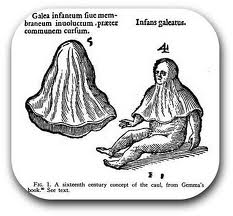
The Caul off the head of a new born baby is protection against drowning and will bring good luck to the one who carries it.
A sailor who died from violence or who was lost at sea was said to go to Davy Jones’s locker. A sailor with 50 years of service was said to go to Fiddlers Green when he died.
Finally, if a bride steers a boat on the day of her marriage then the winds and the waves have no power over it. It doesn’t matter how fierce the storm or angry the sea.
There are many more superstitions concerning the sea and those who work and sail upon it.  If you know of any then you might post them on my blog or facebook page. Until then keep your sails dry and the wind at your back. Better still stay on dry land.

The Caul Bearer.


In Superstitions of sea faring folk I mentioned a Caul being used by sailors as a protection against drowning. But what is a Caul?

The Caul Bearer.

Those babies born with a Caul are called Caul bearers and in many cultures it is referred to as The Veil. The Caul is like a mask that is found covering the face of some children at birth. The Caul is formed from the membranes of the amniotic sac that develop during pregnancy which in some cases covers the face and head of the baby.  After the birth, the caul would be carefully removed from the newborn, taking care to keep it as intact as possible. It would then be preserved and would be kept with the child as a protective talisman. To be born with a Caul is an extremely rare occurance and because of this such children were held in high regard and in some cultures feared.

Those born behind the veil can be male or female, rich or poor. They can be from any social, religious or racial group and from any country. There are no barriers when it comes to the Caul Bearers although there may be a genetic tendency so in rare cases there may be more than one member of a family born with a Caul.

There has been some suggestion that these births may be as few as one in a hundred thousand but there has been no definitive study carried out to my knowledge in regard to geographical area or population group.

It has also been suggested that one of the reasons why those born with a Caul are held in high esteem is due to the fact that the time and place of a birth can be predicted. In some cultures the Caul Bearer was considered to be King by right due to the predictive nature of their birth and because they were thought to have great leadership qualities. There are a number of Buddhist groups who will seek out Caulbearers to be reared as a future Dalai Lamas.

Caulbearers are thought to have special abilities which include the ability to find hidden underground water supplies, knowing when the weather will change and predicting future harvest size and where to fish.  They are also known to be great healers who can heal either by laying on of hands or from a far distance (Remote healing). Because of their ability to see beyond the veil they were thought to have second sight and so were able to predict the future. They were also considered to be knowledgeable in matters of judgement and leadership and they are highly respected by many cultures.

However, as I said at the beginning some people and groups feared the Caul bearer and there have been many attempts throughout history to destroy them. Some powerful groups feared the Caul Bearers because they saw them as messengers of a higher force sent to guide mankind in spiritual matters and in times gone by they were held in such high regard for their wide range of knowledge they were looked upon as priests and teachers, this was long before the idea of religious priests was an accepted term. This period of persecution was known as The Veil of Tears and was at its height during the Middle Ages when Caul bearers were burned as witches and heretics mainly by the Church of Rome.

Persons of negative character may often react to Caulbearers at a very subconscious level as they sense that there is something different about these people. There are many folk tales about “the curse of the Caul” which appears to come from the fallout of negative actions against a bearer of the Caul.  This persecution was to receive support from both the ruling class who wished to obtain power through might rather than birthright and the ignorant who were easily led as they feared the unknown and those who were seen as different made easy targets. Nothing much has changed.

Returning to the superstition of sea faring folk. It was believed  that children born with the Caul would never die of drowning and they would make good sailors.  In Victorian times Cauls were even sold at auction and fetched very good prices as they were often bought by seafarers who wished to obtain protection against the dangers of the sea.

The Hellfireclub (Part 2).


The Hellfire Club. Part Two.

There are numerous stories that concern the Hellfire Club and its members:

Simon Luttrell was created Baron Irnham (of Ireland) in 1768 and Earl of Carhampton in 1785. He was a member of the Hellfire Club in Dublin. After the usual fashion of satirizing any unpopular character, the first Lord Irnham was introduced in a satirical ballad, in which the Devil is represented as summoning before him those who had the strongest claim to succeed him as King of Hell.  Having summoned amongst others Lord Lyttleton, the ballad concludes


But as he spoke there issued from the crowd

Irnham the base, the cruel, and the proud

And eagerly he cried, "I boast superior claim

To Hell's dark throne,  Irnham is my name."


He was connected to various scandals one of which concerned a woman who may have been Dublin’s first recognised serial killer, her name was:


Darkey Kelly.

Burned as a 'witch' 250 years ago, however, was really a serial killer?

Darkey Kelly, whose real name was Dorcas Kelly ran a brothel in Copper Alley, off Fishamble Street she claimed to have become pregnant with the child of the city sheriff Simon Luttrell (Lord Carhampton), and she demanded he support her financially. Folklore suggests that he responded to her demands by accusing her of witchcraft and of sacrificing her baby in a satanic ritual, the baby’s body was never found. She was found guilty and sentenced to death. She was partially hanged and then burned at the stake in a public execution on Baggot Street in Dublin. The date was 7th January 1761.

However, it has now been suggested that the real reason for her execution was murder. She was actually accused of the murder of John Dowling, a shoemaker and those investigating the murder were to find the bodies of five other men hidden in the brothel. Reports of rioting in Copper Alley by prostitutes was recorded after her execution. It was because of these murders that some suggest that she may even be Dublin’s first female serial killer?

It has been said that in 18th century Ireland women were second class citizens and this was reflected in the form of execution. Men found guilty of murder were simply hanged whereas women were first throttled then cut down and burnt alive.

In the 1780s Simon Luttrell’s son Henry, who also had the title Lord Carhampton also hit the news. He was accused of raping a young teenage girl in a brothel (like father, like son). The girl was supplied to him by the brothel keeper Maria Lewellyn. By a strange twist of fate, Lewellyn was the sister of Darkey Kelly. Henry Luttrell had the young girl and her parents falsely imprisoned. The girl’s mother died in prison. Luttrell’s charges against the girl and her family were later dismissed in court.

Another aristocratic member of the Hellfire Club was:

Lord Santry.

The Lord Santry Trial’ details the events that took place in 18th century Dublin at the Hell Fire Club. The club had acquired the name, ‘The Devil’s Kitchen’, and its members were called ‘bucks’. They were often the bored sons of the aristocracy who engaged in drunken sexual orgies. One of the leading lights of the Hell Fire Club was Lord Santry, a 29-year-old infamous aristocrat. He caused an outrage when he stabbed a servant, Laughlin Murphy, to death with his sword. 

Following the incident, Santry simply tossed the landlord of the tavern - where the incident occurred - a coin and implied that the whole thing was better hushed up. However, that didn’t happen. Santry was tried for the death of Murphy and found guilty by his peers, causing a major scandal in those times.  Santry never went to the scaffold; he was awarded a full pardon thanks to The Duke of Devonshire, the Lord Lieutenant of Ireland, who had been largely responsible for petitioning King George II on Santry’s behalf.

If Santry had gone to meet his death, it would have been a beheading. Instead he lived to carry on his rakish life. He was attainted, which meant he had to forgo his estate, but that was returned to him after the pardon in 1740. A year after his pardon, Santry travelled to see George II in person and thanked him face to face. On Lord Santry’s death his title became extinct.


The Black Cat of Killakee.


Another story concerns a priest who stumbled across the club’s activities late one night. The members of the club spotted him and held him captive. What he was doing there I’ve no idea maybe he was just having a look to see what was going on. Anyway it is said that he discovered that the centre of attention was a huge black cat. He broke free from his captors, grabbed the cat and said a very quick exorcism.  This is said to have torn the cat apart and from within it a demon shot out went straight through the roof and the whole assembly ran for cover.               


In the early 1960s, workmen renovating a derelict 18th-century farmhouse near the notorious Hellfire Club in Rathfarnham witnessed strange phenomena culminating in the appearance of a gigantic black cat. Artist Tom McAssey, who was helping to convert the house into an arts centre, said the temperature in the old ballroom plummeted suddenly and a locked door swung open, revealing a hideous black cat with blazing red eyes. Afterwards the house was exorcised and no sightings were reported for several years. Then in 1969, a group of actors staying at the centre held a mock séance and apparently invoked the spirits of two women who had assisted at the Hellfire Club’s satanic rituals, during which black cats were worshipped and often sacrificed. The arts centre was replaced with Killakee House, in which a portrait of the hellish cat painted by Tom McAssey glowered down upon brave diners.


Another story tells of a young farmer, who curious to see what took place at the club visited it one dark night. Unfortunately for him he was caught by the members and dragged inside the building and forced to watch the night’s activities.  It was said he was found the following morning wandering the area unable to speak.  He was to remain deaf and dumb for the rest of his days and some say he couldn’t even remember his name.


The area around the Hellfire Club is thought by some to be one of the most haunted places in Ireland, both the Hellfire Club and  nearby Killakee  House are said to be haunted by the ghost of a young male dwarf who was brutally murdered in the Eighteenth century during a ritual at the club. There was a suggestion that he was sacrificed to satan. In 1971 the body of a dwarf was found buried under the kitchen of Killakee House, it was reported that he was found buried with a statue of the devil.

One of the most famous stories told concerns a stranger who called at the club on a stormy night. He was invited in and seeing a poker game in play he asked if he could join in. All was going well until one of the card players dropped a card onto the floor, bending down to pick it up he saw that the stranger had a cloven hoof instead of a foot and confronted the strange visitor.  Letting out a shout he was said to have disappeared through the ceiling in a ball of flame.  There is a very similar story told concerning a card game played at Loftus Hall in County Wexford but it’s not really surprising as the Killakee estate was owned by the Loftus family at one point and they kept a hunting lodge there known as Dolly Mount.

The Hellfire Club (Part 1).


The Hellfire Club. Part One.

Greed, depravity, scandal, and immorality. Why is it that certain individuals work behind the scenes manipulating the strings of government, the church, and seats of power? Maybe we will never really know for sure but one thing we can be sure of these shadows will always feel the need to be drawn together and these are the origins of such places as The Hellfire Club. 

In the early 17th century Europe had entered a new era, that of The Enlightenment. It was also known as the age of reason and was a time when man began to use his reason to discover a new world by casting off the superstition and fear of the medieval world.  In his effort to discover the natural laws which governed the universe he was to make huge scientific, political and social advances. Rational thought and logic was the new belief and this led to the rejection of the authority of both the church and the state. Immanuel Kant expressed the motto of the Enlightenment when he said “Dare to think”.  However The Hellfire Club had its own motto over the entrance to their first building “Do what thou wilt”.

The first Hellfire Club was founded in London in 1719 by a drunkard, aristocrat Philip, Duke of Wharton but it’s his successor Sir Frances Dashwood (Chancellor of the exchequer) who was to go on to gather together what he termed “the most esteemed persons of quality” in Ireland and Britain. Dashwood bought the grounds and subterranean caves of Medmenham Abbey in 1746 and transformed them into a hedonistic playground of transgressions for the wealthy; excesses of food, drink and women, not to mention rumoured blaspheming, Black Masses, Satanic rituals and paganism, sacrificing publically to Bacchus and Venus – gods of wine and sex. This was to become the clubs pervading philosophy. In the years it was in existence it numbered many of the famous within its ranks, people such as Benjamin Franklin and the then Prince of Wales.

The Irish branch was founded in Dublin in 1735 by Richard Parsons, the first Earl of Rosse, he was also the 1st Grand Master of the Irish Freemasons a position he held twice. However, upon inheriting a million pounds from his grandmother (a huge sum in those days) he resigned his position. He then did what most well to do young men did at that time, the Grand Tour. Europe and Egypt and all their mystery’s fell open to him and he began to further his interest in the ‘dark arts’ quickly making a name for himself as a ‘sorcerer and a practitioner of black magic’.

In 1735, he emerged on the Irish social scene and founded the Hellfire Club, as president of the club he dressed as Satan complete with horns, wings and cloven hoofs and called himself The King of Hell. One custom was that of leaving the vice presidents chair unoccupied for the devil, just in case he turned up and the first toast was always drunk in honour of him.  The exact nature of what the members got up to is still open to conjecture but the rumours would make you shiver. Black masses, mock crucifixions, homosexual orgies and prostitutes dressed as nuns. It was even rumoured that servants were doused in brandy and set alight, black cats and even dwarves were sacrificed on an altar.

Lord Rosse never lost his sense of humour. In 1741, as he lay dying at his house on Molesworth Street, he received a letter from Dean Madden, the Vicar of St. Anne's, lambasting him as a blasphemer, scoundrel, gamester and such like, and imploring him to repent of his sins without delay. Noting that the Dean has simply addressed the letter to ‘My Lord’, Rosse put the letter into a fresh envelope and instructed a footman to deliver it to Lord Kildare who lived at nearby Leinster House. The ruse worked a treat and Lord Kildare, one of Dean Madden’s most pious and generous parishioners, was mortified to think the rebuke-filled letter was directed at him. Lord Rosse died before anybody worked it out. He was probably laughing as he went.

The Hell-Fire Club was disbanded following his death.